More Than a Rapper: 5 Surprising Facts That Redefine Tupac Shakur
Get link
Facebook
X
Pinterest
Email
Other Apps
Introduction: Beyond the Headlines
To the world, Tupac Shakur remains an icon frozen in time: the definitive "gangster rapper," the defiant figure at the heart of the East Coast-West Coast hip-hop rivalry, and the tragic subject of an unsolved murder. His image—bandana tied, defiant, and intense—is one of the most recognizable in music history. This persona, amplified by media headlines and his own provocative work, has largely defined his legacy for millions.
But this popular image, while not entirely inaccurate, is a dangerously simplified caricature. Behind the headlines and the hardcore rap tracks was a figure of startling complexity and deep contradictions. The story of Tupac Shakur is not just one of a rapper; it is the story of a classically trained artist, the heir to a revolutionary political legacy, and a vulnerable poet whose work is now studied in the halls of academia.
This article explores five impactful takeaways from his life that reveal the man behind the myth. These facts challenge the one-dimensional caricature and paint a more nuanced portrait of the artist, thinker, and cultural force that many people still don't know.
The "Gangster Rapper" Was a Formally Trained Poet and Shakespearean Actor
Long before Tupac Shakur became a global hip-hop phenomenon, he was a dedicated student of the fine arts. At the prestigious Baltimore School for the Arts, he pursued a rigorous and diverse curriculum that is a world away from the street persona he would later adopt. His formal training included acting, poetry, jazz, and ballet.
This classical education was not a passing interest. Shakur fully immersed himself in the canon, performing in Shakespeare plays and even taking on the role of the Mouse King in a production of The Nutcracker ballet. Crucially, this was not a separate, cordoned-off part of his identity. He saw a direct connection between these two worlds, identifying the themes of Shakespearean tragedy in the patterns of modern gang warfare. This ability to synthesize the conflicts of Elizabethan drama with the realities of street life demonstrates a level of intellectual depth that completely dismantles the media's "gangster rapper" caricature.
His passion for the written word extended to a lifelong dedication to poetry. In 1999, his personal collection of poems, The Rose That Grew From Concrete, was published posthumously, revealing a depth and sensitivity that often went unseen during his lifetime. As noted by author Brittany Kussman, this artistic background provides a powerful counter-narrative to the simplified image the media so often portrayed.
His Political Voice Was a Family Legacy
Tupac's revolutionary consciousness was not an adopted persona; it was his birthright. He was born into a family engaged in high-stakes, life-or-death political warfare, and his worldview was forged in the crucible of the Black Power movement. Both of his parents, Afeni Shakur and Billy Garland, were active members of the Black Panther Party.
Just one month before Tupac was born, his mother was acquitted of over 150 charges in the infamous Panther 21 trial. This revolutionary lineage extended throughout his family: his godfather, Elmer "Geronimo" Pratt, was a high-ranking Panther who spent 27 years in prison for a murder he did not commit, and his godmother and step-aunt, Assata Shakur, escaped from prison and remains on the FBI's Most Wanted Terrorists list. His mother intentionally named him Tupac Amaru after an 18th-century Peruvian revolutionary, explaining, “I wanted him to have the name of revolutionary, indigenous people in the world. I wanted him to know he was part of a world culture and not just from a neighborhood.” As his early manager Leila Steinberg wrote:
“Tupac felt that through art we could incite a new revolution that incorporated the heart, mind, body, spirit, and soul. He wanted his art to instill honesty, integrity, and respect” (xix).
This background demonstrates that the powerful social commentary in his music was not a marketing strategy but the authentic continuation of a family legacy dedicated to challenging injustice.
He Possessed a Vulnerable and Romantic Soul
Beneath the tough, confrontational exterior that defined his public image, Tupac Shakur was a deeply sensitive and romantic individual. This side of his personality is most clearly and powerfully expressed in his poetry, where he explored themes of love, heartache, and profound loneliness with raw emotional honesty.
Literary analysis of his work finds a distinct "Shakespearean presence." Two poems in particular, “‘The Mutual Heartache’ and ‘A Love Unspoken’,” have been compared to a forbidden, Romeo and Juliet-style love, exploring the pain of secret relationships and lovers from different worlds who cannot be together. His work also showcased a striking vulnerability, a stark contrast to the aggression of his rap persona. The opening of his poem "Sometimes I Cry" lays bare a deep sense of isolation:
Sometimes I CrySometimes when I’m aloneI cry because I’m on my ownThe tears I cry R bitter and warmThey flow with life but take no form
This willingness to explore emotional pain and romantic longing reveals a man far more multifaceted than the hardened "thug" identity he often projected.
He Became the First Artist to Have a #1 Album While in Prison
In a powerful and unprecedented display of artistic resonance, Tupac Shakur achieved one of his greatest career milestones while incarcerated. In March 1995, his third album, Me Against the World, debuted at No. 1 on the Billboard200 chart, setting a then record for highest first-week sales for a solo male rapper.
His time in prison was not merely a period of isolation but one of intense intellectual development. Stripped of the distractions of his career, he dedicated himself to reading seminal philosophical and strategic works. He famously studied Niccolò Machiavelli’s The Prince and Sun Tzu’s The Art of War, texts that would heavily influence his later work and his adoption of the alias "Makaveli."
This achievement is remarkable not just as a chart statistic but as a cultural moment. At a time when his physical freedom was completely stripped away, Tupac's voice was arguably at its most powerful and commercially potent, proving that his message could transcend prison walls and connect with millions.
His Legacy is Studied at Harvard and Preserved by the Library of Congress
In the decades since his death, Tupac Shakur's work has transcended pop culture to become a subject of serious academic and institutional recognition. His legacy is now preserved and studied in the same esteemed halls as those of other pivotal 20th-century cultural figures, solidifying his place in American history.
This formal canonization is evidenced by a series of prestigious honors:
• His heartfelt tribute to his mother, "Dear Mama," was added to the National Recording Registry in the Library of Congress in 2010 for its cultural and historical significance.
• In 2003, Harvard University held an academic symposium titled "All Eyez on Me: Tupac Shakur and the Search for the Modern Folk Hero," analyzing his role as an artist and activist.
• Courses dedicated to studying his poetry and history have been taught at major universities, including the University of California, Berkeley.
• In 2017, his first year of eligibility, he was inducted into the Rock and Roll Hall of Fame.
This institutional embrace—from the hallowed halls of Harvard to the nation's official archive—cements his evolution from a controversial pop figure to a permanent and essential fixture in American cultural history.
Conclusion: A Legacy Redefined
Tupac Shakur was a figure of profound and fascinating contradictions. He was a classically trained Shakespearean actor who became a street poet, the heir to a Black Panther legacy who wrote with the soul of a vulnerable romantic, and a self-described "thug nigga intellectual" whose work continues to demand and reward serious study. The five takeaways presented here only scratch the surface of a life and career that consistently defied easy categorization.
By looking beyond the headlines, we discover an artist whose complexity is the very source of his enduring power. As his legacy is further cemented in academia and culture, the central question remains: how do we reconcile the man who studied ballet with the "thug nigga intellectual," and what does our struggle to do so say about our own understanding of art, identity, and revolution?
Akil the MC is Tupac. Akil the MC= I kill the MC. Tupac’s OG name was “MC New York”. Pacs final album was Makaveli which means “I am alive”. Akil the MC has the same voice, teeth, eyes, & BODY LANGUAGE as 2Pac. Every year another hit and now this
Under Covers is a new series tracing the stories behind classic and groundbreaking album artworks. Artist Ronald ‘Riskie’ Brent went from airbrushing t-shirts at the Compton Swap Meet to designing the cover for Tupac’s darkest masterpiece…
The atmosphere of dread that permeates through Tupac Shakur’s dark 1996 masterpiece The Don Killuminati: The 7 Day Theory is so heavy it can feel like you’re sinking in quick sand. Shakur, rapping under the alias of Makaveli due to his admiration for the dictatorial leadership ideals presented in Nicolas Machiavelli’s political treatise The Prince, presents sinister aggression (Against All Odds) and liberating activism (White Man’s World) side-by-side, acutely aware that a black man must wear many masks in order to survive in America.
The 7 Day Theory, named after the condensed period it took to record and mix the album, was released on November 5 1996, less than two months after Shakur, 25, was murdered in a drive-by shooting on the Las Vegas strip, following close friend Mike Tyson’s fight with Bruce Seldon. Subsequently, the record, completed while the West Coast rapper was still alive, naturally inherited an eerie feel.
On Blasphemy, Shakur predicts that living a gangster life will result in his death while weighing up what awaits him in the next world (he speculates: “Everybody kissing ass to go to heaven isn’t going, I put my soul on it!”). The gangster sermon Hail Mary, meanwhile, sounds like Shakur’s spirit is literally haunting the booth, with some of the lyrics – “When they turn out the lights, I’ll be there in the dark” – so chilling they’ll make the hairs stand up on the back of your neck. The fact the record still makes room for music for the clubs (Toss It Up) is testament to Shakur’s infinite range.
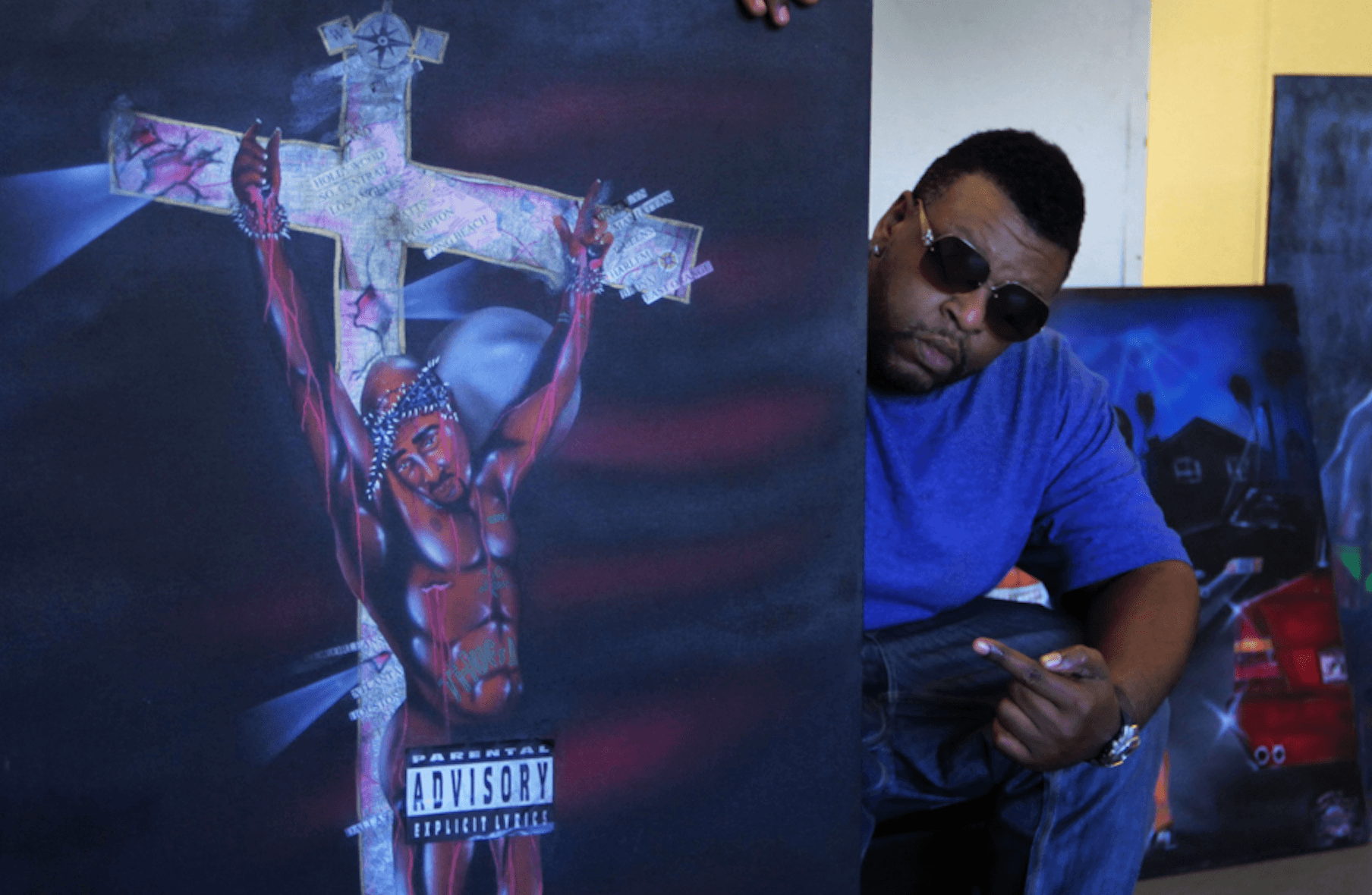
These mostly morbid songs are summarised perfectly by the record’s sinister artwork, which depicts the crucifixion of Shakur. The rapper has mournful eyes and blood trickling down his naked body, the names of American cities pinned to his cross. In 2019, this image feels prescient, Shakur’s corpse the byproduct of an unequal American society that continues to tear down young black men, almost at a whim. The fact this artwork was recently referenced so obviously by West Coast upstart 03 Greedo, for his brilliant God Level album, serves as proof of The 7 Day Theory’s continued cultural relevance.
Compton native Ronald “Riskie” Brent was just 24 when he created this haunting image. He was plucked from relative obscurity by Death Row CEO Suge Knight, who recruited Brent as one of the label’s in-house artists. Crack Magazine caught up with Brent to find out how this haunting artwork came together.
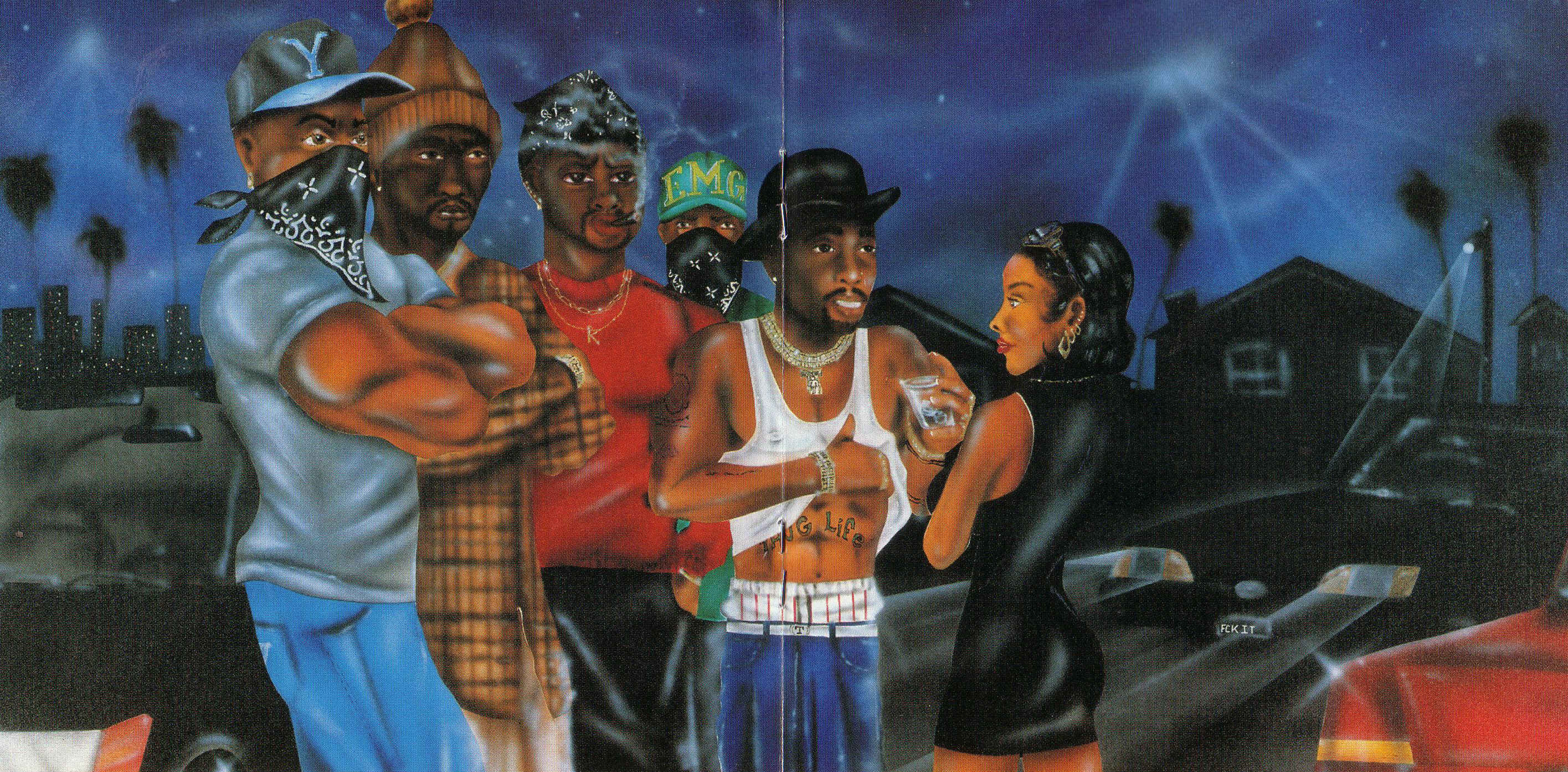
The artwork from All Eyez On Me liner notes by Ronald ‘Riskie’ Brent
You went from doing graffiti and making t-shirts for your friends to working with Tupac Shakur at the height of his career. How did that happen?
My aunt got me into art at a young age. She drew stuff when she would babysit me and I would copy her drawings. When I was in high school, I did graffiti and started airbrushing t-shirts at the Compton Swat Meet and people would pay me well to do their clothes. I developed a buzz around the city and it must have got Suge Knight’s attention.
I give Suge all the credit as he literally plucked me out of the streets and gave me a position at the biggest hip-hop label in the country. The media loves to paint Suge as this bogeyman, but he would pass out turkeys to the poor on Thanksgiving, give out toys to school kids at Christmas and on Mother’s Day he would host Death Row events for mothers without money. A lot of rappers like to rep Compton, but they don’t really give back to the community like Suge did. You gotta remember that nearly every member of the staff at Death Row was someone plucked from the ghetto! It was the very definition of a black-owned label; he gave opportunities to people who had nothing!
Anyways, so Suge showed Tupac my portfolio, he liked it, and from there I did a cartoon for the All Eyez On Me liner notes. I literally started as an in-house artist on Death Row the day Snoop Dogg got acquitted for murder.
What was the atmosphere like? People say the Death Row office was filled with gang members and that fights could break out at any second…
I walked through the door and there’s this huge Death Row platinum plaque on the wall and in front of me is the conference room. There were a lot of the artists in there smoking weed and eating chicken wings. Next thing I know, MC Hammer walks in and says: “Which one of you is Riskie? Suge will be here in a second to talk to you!” I didn’t see Tupac until later that night at Snoop’s acquittal party. Nate Dogg, The Dogg Pound, Snoop… I was surrounded by all these rap titans, it was crazy! Look, I never felt I was in a dangerous situation at Death Row at all! I felt more in danger being in my neighbourhood, surrounded by gangbangers, in Compton than I did at that office. If anything, it kept me out of trouble. It was my safe haven.
What did you learn from Tupac and how did The 7 Day Theory artwork come together?
He was only a year older than me, but Pac was the big homie! He was so generous and a crazy workaholic. I remember I went to his house and Pac had this table set up where he would write. It was surrounded by these opulent red curtains, like this grand cubicle he could concentrate at while writing. It wasn’t an area you would expect a rapper to write at, it looked more like somewhere James Baldwin would write at! When Pac would write, it was like he was putting blocks together. The lyrics just poured out of him so quickly.
Being in the studio with Tupac, he would speak a lot about feeling like he was being crucified by the media and being blamed for things that he didn’t have any control over. The concept [for the artwork] was all his, with the different cities on the cross showing he was the most hated wherever he would go. His crucifixion was supposed to be a statement about race and what it felt like to be young, rich and black in America. The 7 Day Theory was originally going to be this underground album; Pac predicted the rise of mixtapes and was only going to sell it only at the mom-and-pop stores. It only turned into a commercial album after he died.
Do you remember his reaction when he first saw the artwork?
It was September 6, 1996, [the day before Pac was shot in Vegas] and I went to visit him in Malibu, California as Suge wanted a first draft by then! Pac loved it, he was in good spirits and thanked me for making what was in his head a reality. Death Row had just given me a budget to buy more arts supplies and canvases, and Pac wanted me to make paintings for his house. He promised when he got back from Vegas he would host an art show introducing my work to the music industry. Unfortunately, he never made it back.
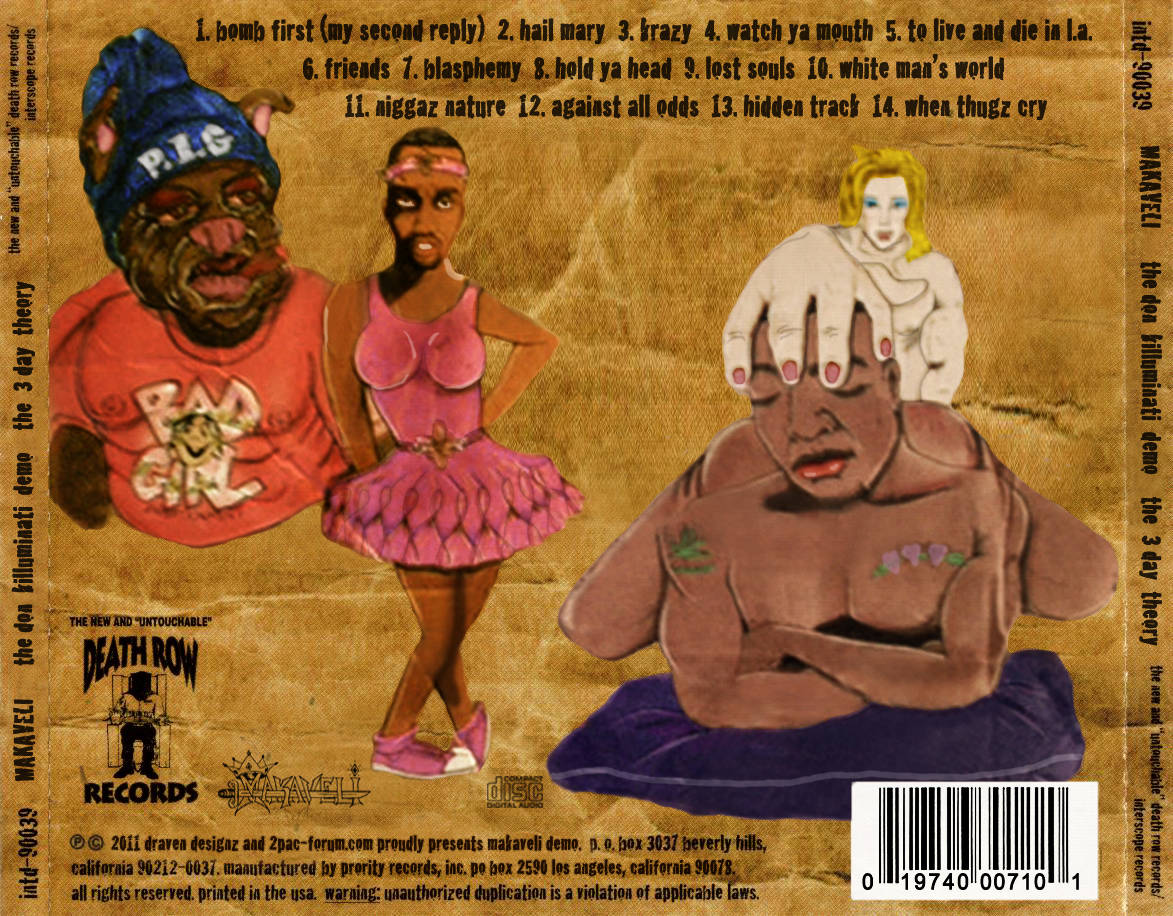
Part of the original artwork, later rejected, featuring Puff Daddy and Biggie
That must have been a bittersweet feeling…
That album is a gift and a curse for me. It’s a gift because I got a chance to work with the greatest rapper of all time and it opened doors for me, but it’s a curse because he died in such a brutal way. It was such a bittersweet moment. The album changed a lot when Pac died, it was no longer a mixtape and they made it into a studio album. The original artwork had images I did of Biggie as a pig and Puffy as a ballerina, because Pac was still at war with them. That all got taken out when it became this commercial project.
I will never forget Tupac’s generosity. You got to remember, I was just some kid at the Compton Swap Meet, but he saw my work and gave me an opportunity. I still live off my work with Death Row, so I owe Suge and Pac everything I have today!
Some people believe The 7 Day Theory is littered with lyrics of Tupac admitting he faked his death. They think the words “Exit Tupac, Enter Makaveli” on the artwork was Pac, like Machiavelli before him, advocating faking one’s death in order to fool their enemies. Did the album have an eerie feel to you when it came out?
It definitely did, but had Pac not died that eeriness wouldn’t have existed. His death made it sound darker than it was. Maybe [ad-libs] and stuff was added to the album after Pac’s death to keep him feeling alive. A lot of people still think I was a vessel for a bigger plan, but look: if Pac was still alive, he couldn’t have kept quiet all these years! He would have come back by now as he was too outspoken. The Outlawz [Tupac’s rap crew] said they smoked Pac’s ashes and I believe them.
YouTube
BIG L WAS PLANNING CRAZY 2PAC, BIGGIE & JAY-Z COLLAB BEFORE HIS DEATH EX-DJ SAYS
Lamont Coleman — better known as Harlem MC Big L — was shot and killed in 1999, bringing his brief yet legendary career to an abrupt end. At just 24 years old, Big L was nowhere near done putting his lyrical talents to good use.
According to Big L’s former collaborative partner DJ Ron G, the late rapper was plotting a track with 2Pac, The Notorious B.I.G. and JAY-Z before his death. During a recent interview with The Art of Dialogue, Ron G was asked how the Big L single “Deadly Combination” featuring 2Pac came to be.
“His dream was he wanted to do a song with Biggie and 2Pac, and he was lyrically nice,” he says in the clip. “So before he got killed, we were sitting in my studio smoking and he’s like, ‘Yo, I just want to do a song with JAY-Z, Biggie and 2Pac.’ I was like, ‘Word.'”
Rawkus Records, DJ Premier and Lord Finesse was working on a Big L album at the time and asked Ron G if he had a song that would make his album sell.
He replied, “I got a few songs with Big L, but I got a song with Big L that I want to put 2Pac on and Biggie on ’cause I have vocals with Biggie, too. When they heard it, they flipped. They lost their mind … Even Premier was like, ‘This crazy, G.'”
After speaking to the Tupac Shakur Estate and Biggie’s mother Voletta Wallace, the song fell apart.
“She [Ms. Wallace] was like, ‘Take my son off of the song,'” he continues. “She was upset that I came to her with the song, and she was also upset that I came there with my lawyer. I never seen Ms. Wallace after that. I just was like, ‘Well, take Biggie off’ and we left it like that.
The song was eventually bootlegged, but “Deadly Combination” with 2Pac did end up getting an official release. The track was included on Big L’s sophomore album The Bigger Picture, which arrived posthumously in 2000.
Smash or Pass Smash Or Pass I Bet on anything right now! DJ FRANK BROWN · Party Chief Radio Restream! Dummy! beefree apsense APSense - The Place To Be, For Professional And Newbie Marketers Alike. The Most Complete Set Of Tools You Will Find Nowhere Else in One Place. Without APSense, You Are Loosing Out On A Great Opportunity To Earn While You Advertise Your Business. How to blow up on YouTube! apsense Cheapest way to make money off your music Best way to Go Viral and top the charts online! Best way to go viral right now! Free way to promote your ads DJ FRANK BROWN · EMAN MOTION REMIX DJ FRANK BROWN · Party Chief Radio DJ FRANK BROWN · PRAISE BREAK Tube Buddy https://www.tubebuddy.com/ KOJI withkoji.com RIQ RIQENGINEERING.COM PPH www.peopleperhour.com LOCAL BITCOINS Localbitcoins.com COINMAMA www.coinmama.com . REBRANDING rebrandabletraffic.com TRIPPLE http://www.triple...
Stocks Under $10 with the Highest Potential to Reach Over $100 Per Share Executive Summary This comprehensive research report analyzes stocks currently trading under $10 that demonstrate the highest potential to reach over $100 per share in the long term. Through rigorous analysis of financial health, growth metrics, industry trends, and market opportunities, we have identified seven high-potential candidates and ranked them according to their likelihood of achieving this ambitious price target. Our research methodology included: 1. Compiling an initial database of stocks under $10 from multiple authoritative sources 2. Establishing clear criteria for shortlisting high- potential candidates 3. Gathering detailed financial and technical data for each shortlisted stock 4. Analyzing growth potential and risks using a consistent framework 5. Validating all data against the most recent financial disclosures (Q1/Q2 2025) The findings reveal that while all shortlisted stocks face significant ...




 frameborder="0" scrolling="no" >

Comments
Post a Comment